

WordPress 7.0 – What to Expect in 2026 (Current Situation and Possibilities)
WordPress 7.0 is already being discussed, even though no release date is set. That alone tells you something important about where the project stands right now.
With WordPress 6.9 now released, attention has naturally shifted toward what comes next. WordPress 7.0 is officially positioned as the first major release of 2026, and early coordination around it has begun. Not because everything is defined, but because contributors are trying to align work earlier, identify gaps, and avoid the kind of last-minute pressure that has shaped past cycles.
Unlike typical release announcements, WordPress 7.0 is being framed as a working space rather than a promise. The scope being discussed is wide, but much of it remains exploratory. Some ideas may mature into core features. Others may stall, change direction, or be deferred entirely.
This has raised questions across the WordPress community. Why is the planning happening so early? Why has development felt slower? What should users realistically expect in 2026?
This article looks at the current state of WordPress 7.0, the factors shaping its timeline, and the possibilities being explored-clearly separating confirmed information from open-ended work. The goal is not to predict the future, but to help WordPress users follow it with context and clarity.
Where WordPress development stands today
A quieter, more deliberate phase
Following the release of WordPress 6.9, the project has entered a quieter but more deliberate phase. Recent cycles have focused less on headline features and more on strengthening foundations that support long-term progress.
What WordPress 6.9 signalled
WordPress 6.9 reflected this shift clearly. Instead of centering on a single defining change, the release delivered a collection of incremental improvements across the editor and admin experience.
Incremental improvements over big changes
Features like Notes, enhancements to the command palette, editor usability refinements, and early groundwork for editor isolation all pointed toward a release designed to improve consistency and readiness rather than redefine how WordPress works.
Gutenberg remains the center of change
Behind the scenes, core development has continued steadily, but with a noticeable change in emphasis. The Gutenberg project remains the primary driver of visible evolution, spanning the block editor, site editor, and emerging collaboration work.
A longer-term roadmap in motion
Much of this aligns with WordPress’s longer-term roadmap, which has progressed from easier content editing, to full site editing, and is now gradually moving toward collaboration and workflow-focused capabilities.
Coordination over deadlines
More recently, core contributors and project leadership have focused on tighter coordination across teams, prioritizing alignment and readiness over rapid feature delivery. Instead of pushing features toward a fixed deadline, work is being surfaced earlier, shared more openly, and evaluated with a longer horizon in mind.
Consolidation, not stagnation
As a result, WordPress development today feels less like a race toward the next major version and more like a consolidation phase. Multiple initiatives are active, but many remain in early or intermediate stages. This is why WordPress 7.0 is being discussed before its shape is fully defined: the goal is to align efforts early, not to commit prematurely.
This current state provides the necessary context for understanding why timelines shifted-and why WordPress 7.0 is taking a different path than originally planned.
Why WordPress 7.0 development has slowed
Speculation vs reality
The slower pace of WordPress 7.0 development has led to speculation across the community. Some have interpreted the delay as a loss of momentum or direction. In reality, the situation is more structural-and more nuanced-than that.
The original 2025 roadmap
Originally, WordPress 7.0 was planned as part of the 2025 release cycle. In late 2024, core contributor Héctor Prieto outlined a roadmap that included three major releases in 2025: WordPress 6.8, 6.9, and 7.0. While WordPress 6.8 shipped as expected, that roadmap did not fully survive the realities that followed.
Legal uncertainty reshapes release planning
By mid-2025, WordPress Executive Director Mary Hubbard announced that there would not be another major release until 2026. She cited ongoing legal matters, referring to the WP Engine lawsuit, as a key factor behind the decision. This was not about a single feature delay, but about risk, governance, and the ability to coordinate a major release responsibly while legal uncertainty remained unresolved.
Automattic’s contribution pause
Around the same time, Automattic paused its WordPress core contributions. Given Automattic’s role as one of the largest corporate contributors to the project, this pause had a tangible impact. Several in-progress initiatives lost momentum, contributor bandwidth tightened, and coordination across teams became more difficult. While WordPress is an open-source project supported by many organizations and individuals, sudden shifts in contribution patterns inevitably affect delivery timelines.
A deliberate slowdown, not a stall
These two factors-legal uncertainty and disrupted contribution flow-combined to slow decision-making and increase caution around major releases. Rather than pushing forward with WordPress 7.0 under constrained conditions, project leadership chose to delay it and refocus efforts on stabilization.
Why WordPress 6.9 returned
WordPress 6.9 was later reintroduced and shipped in December 2025 as a way to restore rhythm to the release cycle. However, it was never intended to “catch up” lost time. Instead, it served as a stabilizing release, allowing contributors to resume work, unblock foundational changes, and prepare for a larger release without compressing timelines.
A shift in cadence and priorities
The resulting cadence change was deliberate. WordPress moved away from a fast, feature-driven schedule toward a slower, coordination-first approach. This shift reflects practical realities more than philosophical ones. The project did not run out of ideas. It chose to create space to align contributors, reduce risk, and avoid shipping a major release before the groundwork was ready.
What the delay actually means
Understanding this context is important. WordPress 7.0 was delayed not because it lacked ambition, but because the conditions required to deliver it responsibly were not fully in place. The current planning process reflects an attempt to rebuild that foundation before committing to outcomes.
Expected release timeline: what 2026 realistically looks like
From vague to tentative dates
At this point, WordPress 7.0 is no longer an abstract “sometime in 2026” release. A proposed schedule is already on the table, giving users a clearer picture of how the year may unfold-while still leaving room for change.
Proposed milestones for WordPress 7.0
According to the proposed 2026 release calendar, WordPress 7.0 is currently targeted for an April 2026 release. The schedule outlines February 19, 2026, as the planned date for Beta 1, followed by Release Candidate 1 on March 19, 2026. If that timeline holds, the final release is expected around April 9, 2026, aligning with WordCamp Asia.
The “Source of Truth” timeline
Alongside this, Jonathan Desrosiers has also shared a tentative timeline for what’s often referred to as the “Source of Truth” for WordPress 7.0-the document that consolidates scope, priorities, and release details. Under the current plan, a first public draft would be available for preview on February 26, 2026, with a published version following on March 26, 2026, assuming approval from the release squad.
What these dates actually mean
It’s important to understand how these dates function within the WordPress project. While they are concrete enough to guide planning, they are still proposed, not guaranteed. Major WordPress releases often adjust as work progresses, especially when scope remains fluid and large features are still being evaluated. The presence of beta and RC milestones signals seriousness and momentum, but not immutability.
Looking beyond the first 2026 release
Looking beyond 7.0, the same proposed schedule suggests a more active release cadence for the rest of the year. WordPress 7.1 is tentatively planned for August 2026, with WordPress 7.2 following toward the end of the year, around December and the State of the Word period. This points to a return to a more predictable rhythm once WordPress 7.0 establishes the baseline.
How users should read the timeline
In practical terms, users should treat the current WordPress 7.0 timeline as directionally reliable. The project is clearly aiming for a spring 2026 release, but final dates will depend on how much of the planned work stabilizes in time. The emphasis, for now, is on readiness rather than speed.
Major and minor releases in 2026: what to expect
A return to a predictable cadence
By 2026, the WordPress release cycle starts to look more predictable again. Current planning points to a return to three major releases within the year, with WordPress 7.0 expected to arrive first, likely in March or April.
Major vs minor releases, explained
For context, major WordPress releases introduce new features, larger architectural changes, and user-facing improvements. Minor releases, on the other hand, focus on maintenance: bug fixes, security patches, and small refinements. While both are important, major releases are where direction is set and long-term priorities become visible.
Why the distinction matters
This distinction matters because it shapes how users, agencies, and plugin developers prepare. A stable major-release cadence allows the ecosystem to plan upgrades, testing cycles, and feature adoption with more confidence.
A sign of recovered capacity
The return to three major releases also signals something broader. After the turbulence of 2025, WordPress appears to have regained enough contributor capacity to support its traditional rhythm. The legal issues that affected planning have not disappeared entirely, but the project is no longer operating in a holding pattern. Development has moved from uncertainty toward structured planning.
Planning beyond the first release
That shift is visible in how leadership and contributors are talking about the year ahead. Notes from the quarterly core committers check-in show discussions already underway for features beyond WordPress 7.0, including early consideration of what could land in WordPress 7.1. This kind of forward planning was largely absent during the middle of 2025, when timelines were compressed and priorities kept changing.
What’s still undecided
What remains unresolved is the exact schedule for all three major releases in 2026. While proposed dates exist for WordPress 7.0, the full release calendar has not yet been finalized. One of the follow-up items from the core committers meeting explicitly mentions publishing the 2026 release schedule, which suggests more clarity is expected in early 2026.
Benefits of this release model
There are clear advantages to this release model. A predictable cadence helps restore confidence across the ecosystem, reduces pressure to overload individual releases, and allows features to mature over multiple cycles instead of being rushed. It also gives users more frequent opportunities to benefit from improvements without waiting an entire year.
Trade-offs to keep in mind
At the same time, there are trade-offs. More major releases mean more frequent testing, higher coordination demands, and a continued need for restraint around scope. For WordPress 7.0 in particular, this increases the likelihood that some in-progress features will be deferred to 7.1 or later-by design, not by failure.
Setting the tone for the year
Overall, the 2026 release plan reflects a project that is no longer trying to catch up, but is instead re-establishing a sustainable pace. WordPress 7.0 sets the tone, while subsequent releases are expected to build incrementally rather than dramatically.
What “WordPress 7.0” will probably focus on
To understand what WordPress 7.0 is aiming for, it helps to zoom out. Much of the work currently associated with 7.0 sits within Phase 3 of the Gutenberg roadmap: Collaboration and workflows. This phase follows the block editor (Phase 1) and Full Site Editing (Phase 2), and it represents a shift from individual content creation toward team-based publishing.
The direction is clear. The delivery, however, will be gradual.
Collaboration and workflows: the core theme of 7.0
Collaboration is the most visible and most discussed focus area for WordPress 7.0. But it’s important to separate what is already happening from what is still being explored.
The first meaningful Phase 3 feature shipped in WordPress 6.9 with Notes. Notes introduced asynchronous collaboration directly inside the editor, allowing users to leave block-level comments, reply, resolve discussions, and move content forward without relying on external tools. For many teams, this already replaces large parts of email-based or Google Docs–based feedback loops.
In WordPress 7.0, Notes are expected to evolve further. Planned improvements include fragment-level notes that target specific text within blocks, “@” mentions, digest-style notifications, improved layouts for larger screens, and broader support across the Site Editor. These enhancements build directly on an existing foundation and are widely expected to land.
Real-time collaboration, by contrast, remains a possible inclusion rather than a confirmed one. The vision is familiar: multiple users editing the same content simultaneously, live cursors, and instant updates. From an editor perspective, this work is already in good shape. The larger challenge is infrastructure.
As Gutenberg lead architect Matías Ventura has repeatedly emphasized, WordPress features need to work across a wide range of hosting environments. Many PHP hosting setups do not support persistent WebSocket connections, which are typically required for performant real-time collaboration. While WordPress VIP has open-sourced a WebSocket-based implementation that works at enterprise scale, making this universally available remains unresolved.
Because of that, real-time collaboration is best viewed as in progress, not guaranteed. It may appear in WordPress 7.0 in a limited or baseline form, or it may be deferred to a later release once infrastructure questions are settled.
Admin redesign: incremental, not a reset
The WordPress admin redesign is also part of Phase 3, but it is progressing deliberately. Early previews were originally planned for WordPress 6.9, then shelved when it became clear the work was not mature enough to ship responsibly.
Rather than a full overhaul, current discussions describe the redesign as a “coat-of-paint” refresh. The goal is to modernize wp-admin visually and structurally, reduce inconsistencies between legacy screens and newer editor experiences, and align the admin more closely with the WordPress Design System.
What is shipping is foundational work. Components like DataViews and DataForm, introduced and expanded in recent releases, are quietly reshaping how admin screens are built. They enable richer filtering, grouping, persistent views, and more flexible layouts. WordPress 7.0 is expected to continue expanding these building blocks, even if the completely redesigned admin does not arrive yet.
In short, users should expect visible refinement, not a dramatic interface reset.
AI capabilities: infrastructure before features
AI-related work is another area where expectations need careful framing. WordPress is not positioning itself as an AI-first CMS, but it is laying the groundwork for AI-assisted workflows.
Two key initiatives are in play. The Abilities API, introduced in WordPress 6.9, provides a structured way for AI systems to understand what WordPress can do. Enhancements to this API are being developed and are likely to continue in WordPress 7.0.
Alongside that, the WordPress AI Client has been discussed as a possible 7.0 feature. If it ships, it would offer a standardized way for plugins and core features to interact with AI services without hard-coding specific providers into WordPress itself. This keeps WordPress flexible while allowing experimentation.
These efforts are largely infrastructural. Users should not expect WordPress 7.0 to suddenly generate content autonomously, but they may see early integrations and APIs that make future AI-powered features easier to build.
Platform-level changes: preparing for what comes next
Some of the most impactful changes in WordPress 7.0 may not be immediately visible. One example is the proposed minimum PHP version bump to 7.4, discussed during core committers meetings. This would allow WordPress to use more modern language features, improve maintainability, and better support AI-related tooling that depends on newer PHP versions.
There are also ongoing efforts to further isolate the editor from wp-admin styles and third-party scripts through iframe-based rendering, work that began in WordPress 6.9. While this improves consistency and stability, it may surface compatibility issues with older or unmaintained blocks, making it another area where caution is warranted.
What not to expect
Not everything discussed will land in WordPress 7.0. Some features will move to 7.1 or later by design. Others may remain experimental. One thing that is notably not planned is a new default theme. With block themes now mature, WordPress has deprioritized releasing a new default theme for every major version.
Overall, WordPress 7.0 is shaping up as a foundation-setting release. It advances collaboration, modernizes key systems, and prepares the platform for future workflows. Its success will be measured less by the number of features it introduces and more by how well it enables what comes next.
Community sentiment: what people are saying
Optimism, tempered with realism
The early response to WordPress 7.0 planning has been broadly positive, but noticeably grounded. Across contributor discussions, the tone is enthusiastic without being naive-people are excited about the scope of work, while remaining realistic about what can actually ship.
Transparency resets expectations
One recurring theme is appreciation for transparency. Many contributors have welcomed the fact that the current list of ideas is being framed explicitly as exploratory, not as a set of commitments. This has helped reset expectations after the uncertainty of 2025. Rather than treating the scope as a promise, contributors are viewing it as a coordination tool-something to align effort early and surface gaps before timelines harden.
Visible ownership builds confidence
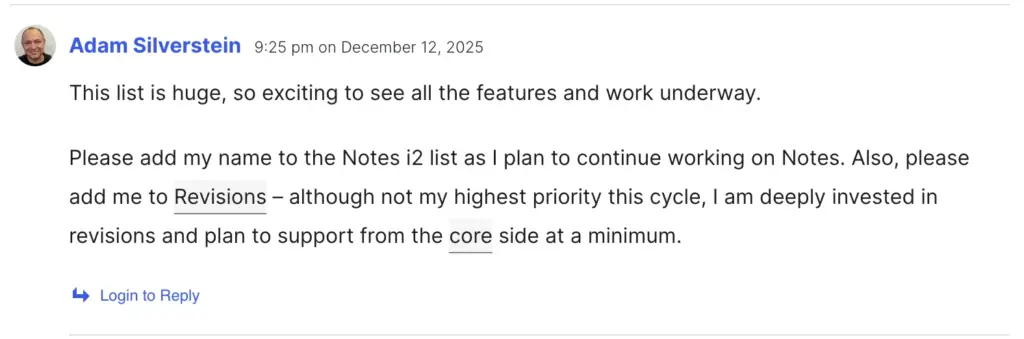
There is also clear momentum behind specific areas of work. Multiple contributors have publicly stepped forward to continue or expand efforts around collaboration features, editor blocks, revisions, admin improvements, and visual transitions. This visible ownership suggests that much of the roadmap is already backed by active contributors, even if delivery timelines remain flexible.
Responsiveness remains a sensitive topic
At the same time, the discussion reflects long-standing practical concerns. Responsiveness, for example, continues to be a sensitive topic. Questions about whether responsive editing is truly becoming a priority were met with clarifications that this work is already in progress and builds on improvements from recent releases. The exchange highlights a broader challenge: much of WordPress’s progress happens incrementally and is easy to miss unless you closely follow development updates.
Developer foundations matter too
Technical contributors have also raised issues that don’t always surface in high-level roadmaps. Requests for updates to testing infrastructure, compatibility with newer tooling, and improvements to developer workflows show that not all critical work is user-facing. For many contributors, strengthening these foundations is essential to sustaining faster progress later.
Feedback on process and sustainability
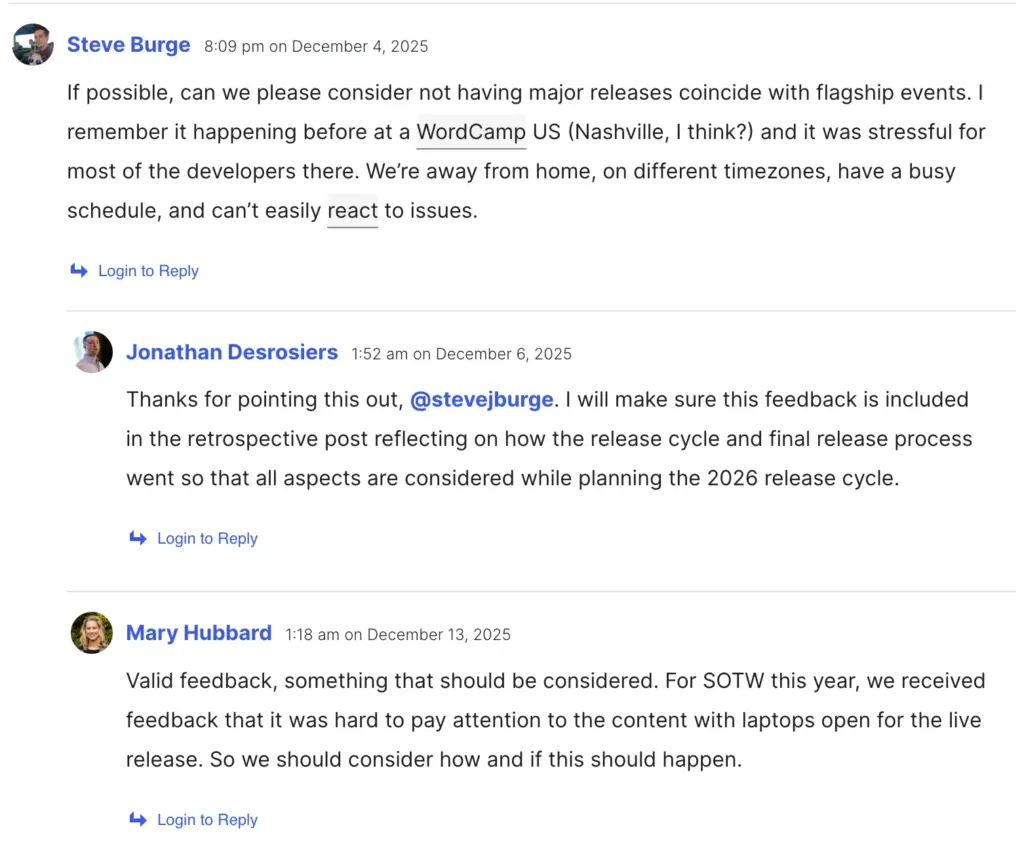
Process-related feedback has been equally prominent. Several contributors expressed concern about major releases coinciding with flagship WordPress events, describing past experiences as stressful and distracting. Importantly, this feedback was not dismissed. It was acknowledged as something to be considered in future release planning, signaling a willingness to reflect on how release timing affects contributor well-being.
Open questions still remain
There are also open questions that remain unresolved. Requests for clarity around native multilingual support, for example, reveal a segment of users actively deciding whether to wait for core solutions or continue relying on third-party plugins. These comments underscore the importance of communication alongside delivery, especially when timelines are uncertain.
A healthier overall tone
Overall, the community response to WordPress 7.0 feels measured and constructive. Contributors are engaged, work is clearly underway, and expectations are more realistic than in previous cycles. Rather than demanding faster releases or bigger promises, the prevailing sentiment favors coordination, clarity, and sustainable progress.
That mindset may be one of the most encouraging signs for WordPress 7.0-not because it guarantees specific features, but because it reflects a healthier approach to building them.
How users can contribute right now
The planning for WordPress 7.0 is focused on coordination, not feature requests. The current discussions are meant to make visible who is working on what, identify gaps early, and reduce duplicated effort-not to lock scope.
Feedback, bug reports, and technical discussions belong in GitHub and Trac. The planning posts exist to help contributors align, share ongoing work, and step into areas that still need help.
The list of ideas is intentionally exploratory. Some items are already in progress, others are still early, and not all will ship in WordPress 7.0. Progress markers indicate work underway, not guarantees.
For non-code contributors, testing new features, following development updates, and providing clear feedback through official channels are still meaningful ways to contribute. At this stage, clarity and early signals matter more than speed.
How to prepare your site and workflow for WordPress 7.0
WordPress 7.0 is still months away, and there’s no need for immediate action. Preparation at this stage is about readiness, not upgrades.
For site owners and marketers, the most important step is to keep fundamentals solid. Stay current with updates, avoid heavily outdated themes or plugins, and make sure your site can be tested safely in a staging environment. As editor and admin changes continue to evolve, compatibility will matter more than chasing new features early.
It’s also a good time to pay attention to how you use the block editor today. Many of the improvements planned for 7.0 build directly on existing workflows. Teams that are already comfortable with blocks, patterns, and site editing will find future changes easier to adopt.
Agencies and teams managing multiple sites should plan for testing windows, not migration deadlines. Expect gradual changes across releases rather than a single disruptive update. Monitoring beta and RC releases later in the cycle will provide far more value than reacting on release day.
Most importantly, adjust expectations. WordPress 7.0 is designed to strengthen foundations-collaboration, consistency, and infrastructure-rather than introduce instant visual overhauls. Preparing mentally for incremental improvement will lead to better decisions than waiting for a dramatic shift.
Enjoying this article?
We regularly publish actionable content on our blog. Subscribe to get them delivered straight to your inbox.
We won’t spam you. You can unsubscribe whenever you want.
Conclusion: steady progress, not sudden change
This upcoming major release reflects a shift in how the WordPress project is moving forward. After a turbulent period, the focus is now on coordination, sustainability, and setting strong foundations rather than pushing for rapid delivery.
The slower pace is intentional. Planning has started earlier, expectations are clearer, and contributors are aligning work before committing to outcomes. Some of the ideas being discussed today will land in the first release of 2026. Others will move to later versions-and that restraint is part of the strategy, not a failure.
What matters most is the direction. Collaboration, consistency, and infrastructure improvements point to a platform preparing for long-term workflows rather than short-term wins. Progress may feel less dramatic, but it is more deliberate.
As timelines solidify and features take shape, the story will continue to evolve. If you want to stay updated with clear context, realistic expectations, and ongoing analysis around the WordPress 7 release cycle, Subscribe us for the latest updates.

This is Sumit. He’s a physics major who’s trying to understand both the physical as well as the WordPress worlds. Whenever he’s not busy, plays fifa or spends time with his family.


Leave a Reply